WEEK 5 Assignment: Assessing for Emotional Intelligence

You can find many models of emotional intelligence, also called EI or EQ. One of the most widely known and studied models is Goleman’s model of emotional intelligence, which identifies five components of emotional intelligence. As you review each element of Goleman’s model, consider your own level of EI, using the study question listed below. Self-awareness
Self-regulation
Motivation
Empathy
Social Skill
Adapted from Goleman, D. (1998). What makes a leader? Harvard Business Review, 82(1), 82–91. |
Assignment Prompt
Prior to beginning work on this assignment, read the articles by Afrifa et al. (2021), Edelman and van Knippenberg (2018), and Kim et al. (2021).
Competence, technical skills, integrity, and determination are traits most people would agree are important for leadership. But what about self-awareness, self-regulation, motivation, empathy, and social skills? Daniel Goleman, author of numerous books and articles on emotional intelligence, including his seminal work Emotional Intelligence (1995), believed these “softer skill” traits, which are associated with emotional intelligence (EI), are equally important for leaders. In fact, some would argue that emotional intelligence, as opposed to cognitive ability, is the key to successful leadership performance.
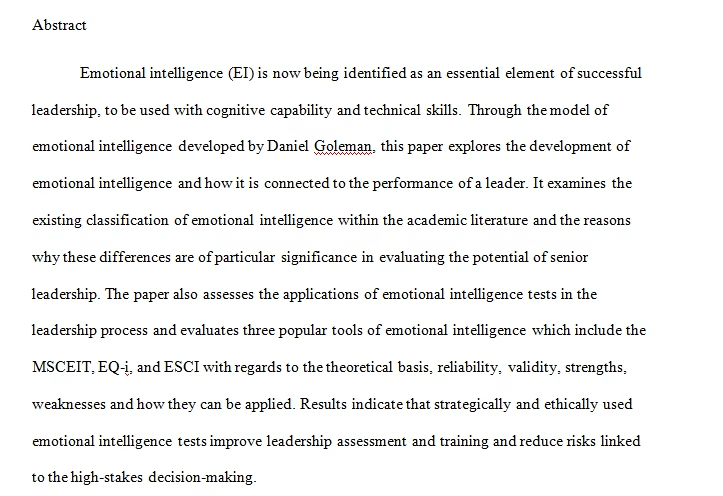
In a paper of at least 1,200 words (exclusive of title, abstract, and reference pages) and citing at least two scholarly sources in addition to required readings, analyze the use of assessments of emotional intelligence.
In Part One of your paper,
- Discuss the concept of EI and its evolution as a factor associated with leadership performance.
- Describe how researchers classify EI—as a distinct component of intelligence or as a set of personality or behavioral characteristics.
- Explain why the classification is important when considering the use of EI assessments for senior leadership.
- Analyze the use of assessments of emotional intelligence in evaluating the potential of individuals for senior leadership positions.
- Justify the use of EI assessments when considering leadership candidates
In Part Two of your paper,
- Select three specific EI assessments.
- Describe the theoretical framework upon which each assessment is based, typical uses for each assessment, and the target population(s) for each.
- Discuss each instrument’s reliability and validity.
- Analyze the advantages and disadvantages of using each assessment for its intended purpose.
- Propose when you would recommend using each assessment and when would you NOT recommend using them.
The Assessing for Emotional Intelligence paper
- must be at least 1,200 words in length (not including abstract, title, and reference pages) and formatted according to APA StyleLinks to an external site. and APA Style ElementsLinks to an external site. as outlined in the Writing Center’s APA Formatting for Microsoft Word resource.Links to an external site.
- must include a separate title page with the following in title case:
- title of paper in bold font
- Space should appear between the title and the rest of the information on the title page.
- student’s name
- name of institution (The University of Arizona Global Campus)
- course name and number
- instructor’s name
- due date
- title of paper in bold font
- must utilize academic voice.
- See the Academic VoiceLinks to an external site. resource for additional guidance.
- must include an introduction and conclusion paragraph.
- Your introduction paragraph needs to end with a clear thesis statement that indicates the purpose of your paper.
- For assistance on writing Introductions & ConclusionsLinks to an external site. and Writing a Thesis StatementLinks to an external site., refer to the Writing Center resources.
- must use at least two scholarly sources in addition to required readings.
- The Scholarly, Peer-Reviewed, and Other Credible SourcesLinks to an external site. table offers additional guidance on appropriate source types. If you have questions about whether a specific source is appropriate for this assignment, please contact your instructor. Your instructor has the final say about the appropriateness of a specific source.
- To assist you in completing the research required for this assignment, view this Quick and Easy Library ResearchLinks to an external site. tutorial, which introduces the University of Arizona Global Campus Library and the research process, and provides some library search tips.
- must document any information used from sources in APA Style as outlined in the Writing Center’s APA: Citing Within Your PaperLinks to an external site.
- must include separate abstract and reference pages that are formatted according to APA Style as outlined in the Writing Center.
See the Writing an AbstractLinks to an external site. and APA: Formatting Your References ListLinks to an external site. resources in the Writing Center for specifications.
Tutorial for Assessing for Emotional Intelligence