WEEK 3 DISCUSSION: Discussion Prompt

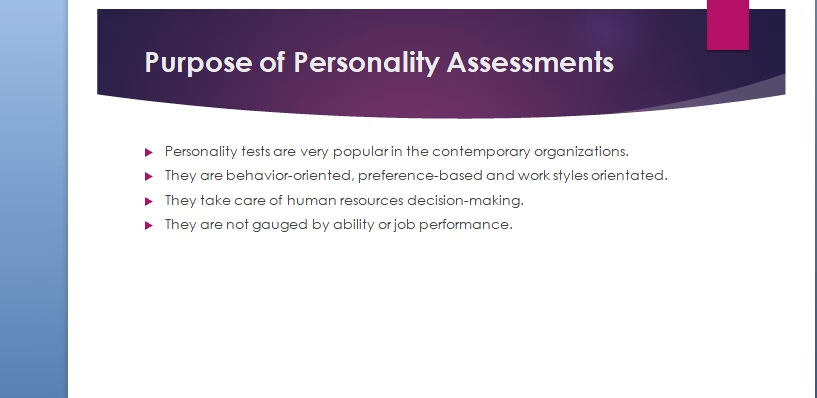
Most of you reading this have likely taken a personality assessment sometime during your work career. The purpose may have been for employment, team building, or professional development. Whatever the reason, most of us are familiar with at least a few different kinds of personality assessments. And most of us probably enjoyed learning something about ourselves as we reviewed the results of our assessment. Taking the assessment may even have been fun! However, personality assessments are serious business in many U. S. organizations and are commonly used to guide human resources decisions. Most HR managers would tell you that personality assessments help determine whether the individual being considered for hire, promotion, professional development, or some other personnel action is a good fit for the organizational culture and the demands of the job or the training program. Personality assessments can provide a snapshot of an individual’s qualities and characteristics in the human domain. The assessments may help distinguish between candidates in terms of communication style and preferences, work habits, decision making style, teamwork inclinations, and other such factors. These may help a decision-maker determine if a person would be a good choice for an organization or a team, or for a professional development opportunity. On the downside, some assessment experts believe caution should be exercised in using personality assessments to drive decision making. Concerns about using these types of assessments include the ability for someone to “fake good,” or to answer questions on an assessment in ways they believe would make them appear more favorable in the eyes of the decision maker. This concept is called social desirability and occurs when people are motivated to present themselves in the best light. This may lead them to answer as they think would be best in the eyes of the assessment administrator as opposed to what might actually be true for the person themself. Moreover, many assessment experts urge caution in that a test of personality is typically not in and of itself a valid assessment of ability. If personality assessments are used, they should be used in concert with other decision-making strategies, such as interviews, situational judgement tests, and other such assessments of personal skills and work-related abilities. |
Discussion Prompt
Prior to beginning work on this discussion forum, read Chapter 8 by Hughes and Batey (2017) in The Wiley Blackwell Handbook of the Psychology of Recruitment, Selection and Employee Retention Read the articles by Jelley (2021) and Lundgren et al. (2017).
Personality assessments are widely used in the workplace for purposes of personal growth, career guidance, and personnel selection. You are a newly appointed Human Resources Director and have been asked to prepare a presentation for the management team in your organization on using personality assessments for purposes of personal growth, career guidance, and personnel selection.
For your initial post, create a PowerPointLinks to an external site.-training presentation of at least eight slides (not including the title and reference list slides), including at least 50 words of speaker notes for each slide and citing at least two scholarly sources. In the PowerPoint presentation,
- Analyze the use of personality assessments in the workplace, identifying when and how they are commonly used.
- Discuss the kind of information that personality assessments can yield and the potential usefulness of this information for individuals taking the assessment.
- Discuss the concerns practitioners have about using personality assessments.
- In what circumstances would you recommend that your organization administer a personality assessment such as the MBTI or DiSC assessment?
- In what circumstances would you not recommend using a personality assessment?
- Summarize your conclusions about using personality assessments for purposes of personal growth, career guidance, and personnel selection.
Post your PowerPoint-training presentation as an attachment to your discussion, and include a brief commentary in the discussion textbox that would serve to introduce the training presentation to the management team (e.g., What they would learn by participating in the training session?). You can write this as a short (50- to 75-word) email or memo to the team, explaining what the training will cover and why it is important for them to attend.
Tutorial for Discussion Prompt