Week 1: Practice Problems with Solutions
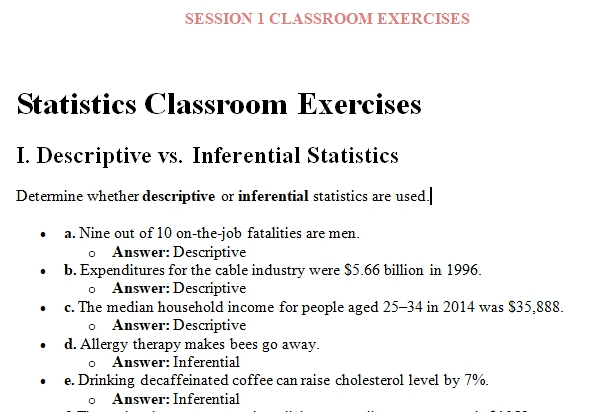
- In each statement, determine whether descriptive or inferential statistics have been used.
- Nine out of 10 on-the-job fatalities are men.
- Expenditures for the cable industry were $5.66 billion in 1996.
- The median household income for people aged 25-34 in 2014 was $35,888.
- Allergy therapy makes bees go away.
- Drinking decaffeinated coffee can raise cholesterol level by 7%.
- The national average annual medicine expenditure per person is $1052.
- Experts say that mortgage rates may soon hit bottom.
- Determine the measurement scale and type: ratio, numerical; interval, numerical; nominal, categorical; and ordinal categorical.
- Pages in the city of Cleveland telephone book.
- Rankings of tennis players.
- Weights of air conditioners.
- Temperatures inside 10 refrigerators.
- Salaries of the top five CEOs in the United States.
- Ratings of eight local plays (poor, fair, good, excellent)
- Times required for mechanics to do a tune-up.
- Ages of students in a classroom.
- Marital status of patients in a physician’s office.
- Horsepower of tractor engines.
- Classify the variables in the paragraph below as numerical and continuous; numerical and discrete; categorical; ordinal scale.
Windjammer Wines owns a fleet of vans for delivery to customers. They buy three different van sizes: compact, midsize, and oversize. Delivery charges depend on the amount of the sale, and the trip distance. During its busy season the store makes between 70 and 120 deliveries every day. Van drivers are paid according to the hours they work, receiving overtime pay for shifts that run more than 8 hours. The vans are replaced when mileage exceeds 100,000. The vans are all painted with the Windjammer white clipper ship logo against a background color of either blue, green, or yellow.
- Population vs. Sample
Most analysts focus on the cost of tuition as the way to measure the cost of a college education. But incidentals, such as textbook costs, are rarely considered. A researcher at Drummand University wishes to estimate the textbook costs of first-year students at Drummand. To do so, she monitored the textbook cost of 250 first-year students and found that their average textbook cost was $600 per semester.
- Identify the population of interest to the researcher.
- Identify the sample in the study
- Classify each sample as random, systematic, stratified or cluster.
- In a large school district, all teachers from two buildings are interviewed to determine whether they believe the students have less homework to do now than in previous years.
- Every seventh customer entering a shopping mall is asked to select her or his favorite store.
- Nursing supervisors are selected using random numbers in order to determine annual salaries.
- Every 100th hamburger manufactured is checked to determine its fat content.
- Mail carriers of a large city are divided into four groups according to gender (male or female) and according to whether they walk or ride on their routes. Then 10 are selected from each group and interviewed to determine whether they have been bitten by a dog in the last year.
Tutorial for Practice Problems with Solutions