Week 13: Linear Regression Analysis
Question 1
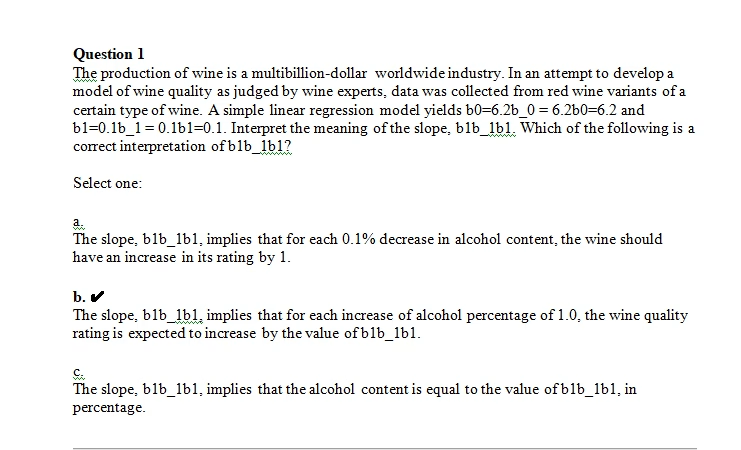
The production of wine is a multibillion-dollar worldwide industry. In an attempt to develop a model of wine quality as judged by wine experts, data was collected from red wine variants of a certain type of wine. A simple linear regression model yields b0=6.2b_0 = 6.2 and b1=0.1b_1 = 0.1. Interpret the meaning of the slope, b1b_1. Which of the following is a correct interpretation of b1b_1?
Select one:
a.
The slope, b1b_1, implies that for each 0.1% decrease in alcohol content, the wine should have an increase in its rating by 1.
b.
The slope, b1b_1, implies that for each increase of alcohol percentage of 1.0, the wine quality rating is expected to increase by the value of b1b_1.
c.
The slope, b1b_1, implies that the alcohol content is equal to the value of b1b_1, in percentage.
Question 2
For the same wine quality regression model as in question 1, with b0=6.2b_0 = 6.2, b1=0.1b_1 = 0.1, if the value of the alcohol content is 12.9, which of the following is the correct prediction value of the quality of wine?
Select one:
a. 7.29
b. 7.39
c. 7.49
Question 3
If the value of the independent variable in a simple linear regression model ranges from 5 to 37, which of the following is an incorrect value for prediction of the dependent variable?
Select one:
a. 9
b. 36
c. 41
Question 4
The plot shown below provides a residual plot from a regression analysis. Is there any evidence of a pattern in the residuals? Choose the correct answer below.
Select one:
a. The residuals show a cyclical pattern.
b. The residuals show a curvilinear pattern.
c. The residuals appear to be randomly spread.
Question 5
How do you interpret a coefficient of determination equal to 0.13? Choose the correct answer.
Select one:
a. The interpretation is that 87% of the variation in the dependent variable can be explained by the variation in the independent variable.
b. The interpretation is that 13% of the variation in the dependent variable can be explained by the variation in the independent variable.
c. The interpretation is that 13% of the variation in the independent variable can be explained by the variation in the dependent variable.
Question 6
What does the standard error of the estimate represent? Choose the correct answer.
Select one:
a. The standard error of the estimate represents the variability in the independent value and sample size.
b. The standard error of the estimate represents the variability of the residuals.
c. The standard error of the estimate represents the variability of the dependent values from the predicted values.
Question 7
If SSR = 21,937 and SSE = 11,355, what is the coefficient of determination? (Use 2 decimal places)
Select one:
a. 0.76
b. 0.66
c. 0.86
Question 8
If SST = 5,634 and SSE = 1,249, what is the coefficient of determination? (Use only two decimal places)
Select one:
a. 0.79
b. 0.81
c. 0.71
Question 9
If SSE = 12.78 for a sample size of 18, what is the standard error of the estimate? (Use 2 decimal places)
Select one:
a. 0.79
b. 0.85
c. 0.89
Question 10
Why should you always carry out a residual analysis as part of a regression model?
Select one:
a. Residual analysis gives a better estimation of the variability of the independent variable.
b. Residual analysis helps with estimation of the intercept and the slope of the regression line.
c. Unless a residual analysis is undertaken, you will not know whether the model fit is appropriate for the data. In addition, residual analysis can be used to check whether the assumptions of regression have been seriously violated.
Tutorial for Linear Regression Analysis