Week 3: Quiz 4
Probability Questions
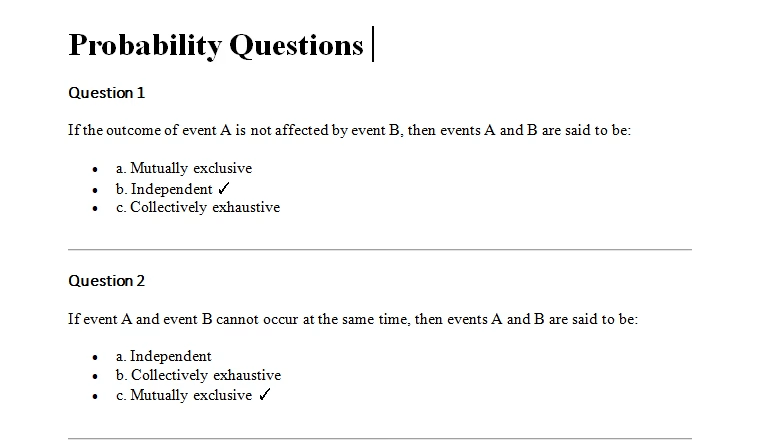
Question 1
If the outcome of event A is not affected by event B, then events A and B are said to be:
-
a. Mutually exclusive
-
b. Independent
-
c. Collectively exhaustive
Question 2
If event A and event B cannot occur at the same time, then events A and B are said to be:
-
a. Independent
-
b. Collectively exhaustive
-
c. Mutually exclusive
Question 3
All the events in the sample space that are not part of a specified event are called:
-
a. Simple event
-
b. Joint event
-
c. The complement of the event
Question 4
The collection of all possible outcomes is called:
-
a. A sample space
-
b. A simple probability
-
c. A marginal probability
Question 5
When using the general multiplication rule, P(A and B)P(A \text{ and } B) is equal to:
-
a. P(A∣B)P(B)P(A|B)P(B)
-
b. P(B)P(A)\frac{P(B)}{P(A)}
-
c. P(A)P(B)\frac{P(A)}{P(B)}
Question 6
A business venture can result in the following outcomes:
-
Highly Successful (10%)
-
Successful (25%)
-
Break Even (25%)
-
Disappointing (20%)
-
Highly Disappointing (?)
If these are the only possible outcomes, what is the probability that the business venture will be highly disappointing?
-
a. 25%
-
b. 15%
-
c. 20%
Question 7
In a company of 600 employees:
-
400 have college degrees
-
100 are single
-
60 are single college graduates
What is the probability that an employee is single or has a college degree?
-
a. 0.533
-
b. 0.667
-
c. 0.733
Question 8
Using the same data as Question 7, what is the probability that an employee is married and has a college degree?
-
a. 0.567
-
b. 0.667
-
c. 0.733
Question 9
If P(A)=0.7P(A) = 0.7, P(B)=0.6P(B) = 0.6, and A and B are independent, what is P(A and B)P(A \text{ and } B)?
-
a. 0.13
-
b. 0.10
-
c. 0.42
Tutorial for Quiz 4